
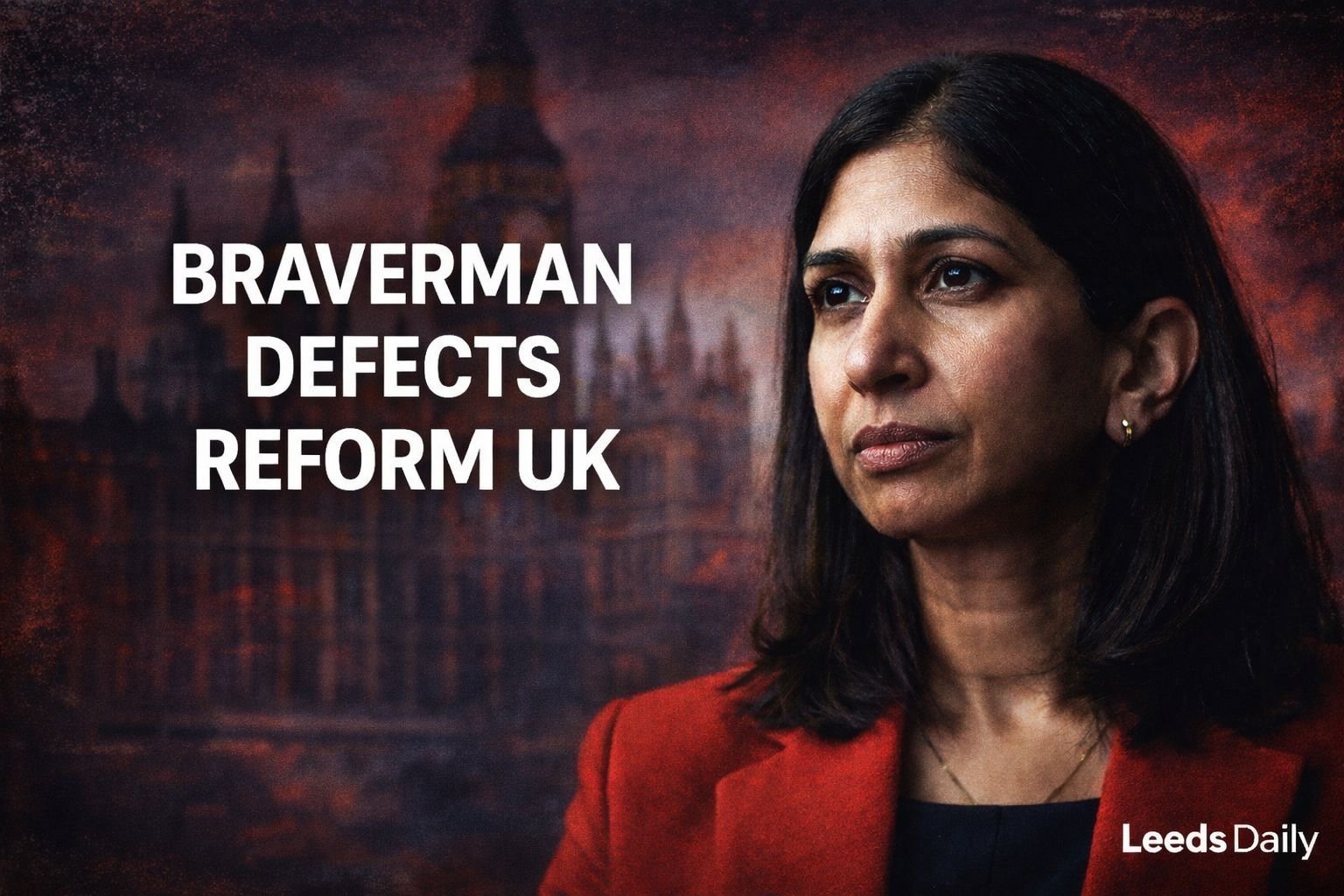
Suella Braverman has formally defected from the Conservative Party to Reform UK, a move that has sent shockwaves through Westminster and is already being felt well beyond London, including here in Leeds and across Yorkshire.
The former Home Secretary confirmed her decision at a London rally, ending decades of Conservative membership and becoming the latest high-profile MP to cross the floor. While the announcement was made in the capital, its implications are being closely watched in northern cities where political loyalties are becoming increasingly fluid.
For many voters in Leeds, the story is less about party manoeuvring and more about what it signals for a political system that appears to be fragmenting at speed.
Why the Timing Matters
Suella Braverman defection comes at a moment of growing instability for Britain’s main parties. Labour, now in government, is facing pressure over immigration, public spending and internal discipline, while the Conservatives continue to struggle with identity and direction following their election defeat.
Across West Yorkshire, conversations about politics have shifted noticeably over the past year. Traditional party allegiances feel weaker, turnout is unpredictable, and there is a growing sense among voters that Westminster politics is failing to reflect everyday concerns around housing costs, public services and community safety.
Reform UK has been quick to frame Suella Braverman move as evidence that it is emerging as a serious national force rather than a protest option. In northern cities like Leeds, that claim is being tested against local realities rather than rhetoric.
Why Braverman Made the Move
Standing alongside Reform leader Nigel Farage, Braverman argued that the Conservatives had failed to deliver on promises around immigration control, law and order and restoring public trust. She said her decision was driven by frustration with what she described as political drift and an inability to confront structural problems.
Central to her argument was opposition to existing international legal frameworks, which she believes limit the government’s ability to enforce immigration rules. These views have long defined her political profile and now place her firmly within Reform UK’s ideological core.
Since leaving the Home Office, Braverman had increasingly positioned herself as a critic of mainstream leadership. Her defection marks a decisive break with the party she once sought to lead.
The Leeds and Yorkshire
In Leeds, the reaction has been mixed and cautious. While the city centre remains broadly progressive, surrounding towns across West and North Yorkshire face long-standing pressures tied to post-industrial decline, strained public services and uneven economic growth.
In those areas, Reform UK’s focus on immigration, national identity and perceived unfairness in the system has gained attention. Suella Braverman arrival gives the party a recognisable national figure who can articulate those concerns with experience from inside government.
At the same time, many residents in Leeds express scepticism about political grandstanding. For voters dealing with rising rents, transport disruption and NHS backlogs, party defections matter less than tangible outcomes.
The divide is not just political, but geographic and generational, with younger urban voters often holding sharply different priorities from older communities in nearby towns.
What Braverman Brings to Reform UK
As Home Secretary, Braverman was closely associated with tough immigration proposals and a combative political style. Supporters view this as proof of conviction; critics argue her approach deepened divisions without resolving underlying problems.
For Reform UK, her presence brings parliamentary experience, media attention and a sharper edge to its policy arguments. The party maintains that existing institutions prevent meaningful reform, a position Suella Braverman now openly supports.
Her defection also reinforces Reform’s attempt to present itself as the primary challenger to both Labour and the Conservatives, particularly in regions where trust in traditional parties has eroded.
Political Reaction and Fallout
The immediate response from other parties has been hostile. Conservatives have sought to downplay the loss, while Labour figures argue that Reform is recycling former ministers rather than offering fresh leadership.
The tone of the fallout has drawn criticism from voters who are increasingly weary of personal attacks and political point-scoring. In Leeds, that fatigue is evident among residents who feel national politics is drifting further from practical problem-solving.
What Happens Next
Attention now turns to upcoming electoral tests, including local elections in May that will serve as an early measure of Reform UK’s strength in northern England. In Yorkshire, council contests will offer insight into whether polling momentum can be converted into real gains.
Political analysts caution that while Reform’s rise is significant, outcomes in cities like Leeds remain uncertain. Voting patterns vary sharply between urban centres, suburbs and former industrial towns.
What is clear is that Suella Braverman move has intensified an already volatile political moment.
What This Means for Voters in Leeds
For Leeds and much of the North, this is not simply about one politician changing parties. It reflects a broader realignment underway in British politics, where old loyalties are weakening and new alliances are forming.
Voters here will judge all parties by their ability to address everyday concerns: affordable housing, reliable transport, secure jobs and functioning public services.
Suella Braverman defection is a symptom of a system under pressure. How northern voters respond may help shape the next phase of UK politics.
Read More: Leeds Council News: The Decisions Raising Bills, Upgrading Homes and Changing Daily Life