
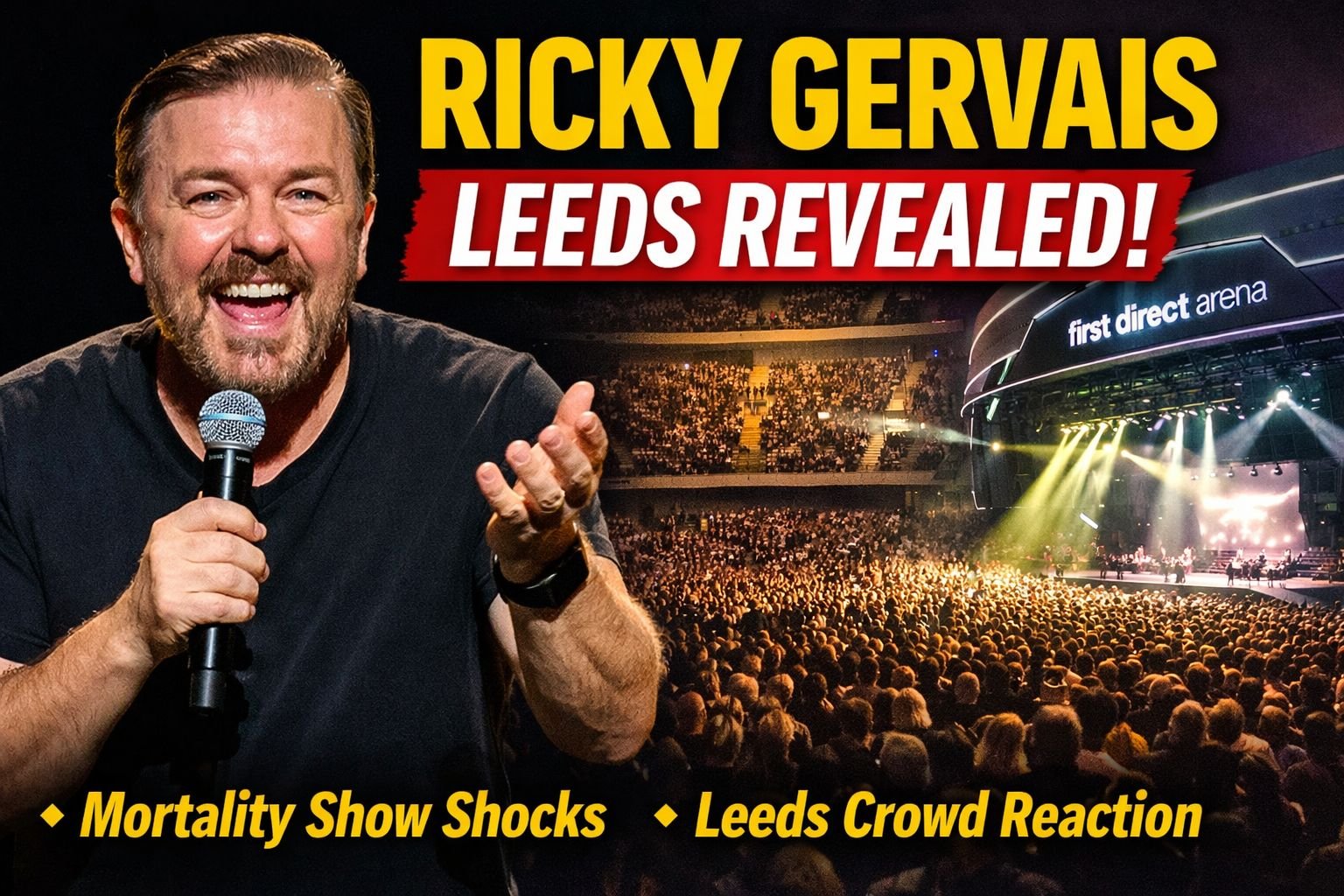
The question was never whether Ricky Gervais would sell out in Leeds. That answer arrived almost instantly when tickets went on sale in December 2024. By the time Gervais stepped onto the stage at First Direct Arena on 26 June 2025, every one of the venue’s 13,500 seats had been taken for weeks.
What mattered far more was how Leeds would respond. This is a city with a reputation for sharp judgement and little tolerance for hype. When Ricky Gervais Leeds becomes a tour stop, the reaction tells you something not just about the comedian, but about the audience itself.
What unfolded that night said as much about Leeds as it did about Gervais.
Why Leeds Still Matters in British Comedy
Leeds has never been a filler date on the UK comedy circuit. Its reputation has been built over decades by audiences who value craft over celebrity and timing over theatrics. While the First Direct Arena has hosted global names since opening in 2013, the city’s comedy roots stretch much further back.
From the City Varieties Music Hall to smaller modern rooms dotted across the city centre, Leeds has always supported live performance. That history shapes expectations. Comics arriving here quickly learn that applause has to be earned, not assumed.
This context matters when assessing Ricky Gervais Leeds. Despite international fame, Netflix deals, and record-breaking tours, Gervais still had to win the room. Leeds audiences are famously direct. If something lands, they laugh loudly. If it doesn’t, the silence is just as clear.
The Mortality Tour Arrives in Leeds
Mortality, Gervais’ fifth major stand-up tour, reached Leeds midway through a global run that had already cemented its commercial power. Following the success of Armageddon, the new show leaned more heavily into personal reflection while retaining the provocation that has come to define his work.
The Ricky Gervais Leeds performance ran for around 90 minutes and followed a familiar structure. Early observational material eased the audience in before the set moved toward darker, more controversial themes. Ageing, death, free speech, and offence formed the spine of the show, framed by Gervais’ long-standing interest in how jokes are interpreted rather than what they reference.
This wasn’t a casual night out. Mortality positioned itself as argument as much as entertainment.
Philosophy, Provocation, and Control of the Room
A notable feature of Mortality was how openly Gervais leaned into philosophical framing. He referenced his academic background and structured several routines around ethical thought experiments. In Leeds, that approach felt deliberate.
Certain sections produced explosive laughter, while others created moments of tension. Rather than smoothing over those pauses, Gervais allowed them to sit. That choice mattered. Leeds crowds tend to respond well to performers who trust them enough not to rush.
The material touched on subjects that have generated controversy elsewhere on the tour. References to historical figures, disability, and gender politics drew mixed reactions in some cities. In Leeds, the response was engaged rather than hostile. Laughter and hesitation coexisted without tipping into disruption.
That balance highlighted the city’s role as an effective testing ground for challenging material.
How the Leeds Audience Responded
By arena standards, the atmosphere felt unusually attentive. There were no significant walkouts and no visible attempts to derail the performance. Instead, the crowd treated each joke on its own terms.
This is an important distinction. Leeds audiences rarely accept material out of loyalty to a performer, but they are equally resistant to performative outrage. The Ricky Gervais Leeds crowd appeared willing to listen first and judge second.
That approach suited Gervais’ central argument. He has consistently claimed that critics confuse the subject of a joke with its target. Whether one agrees with that position or not, Leeds audiences seemed prepared to engage with it seriously rather than ideologically.
The Venue’s Role in the Night
The First Direct Arena played a quiet but significant role in shaping the show. Its fan-shaped design keeps sightlines close and reduces the sense of distance that often undermines arena comedy. Reactions travel quickly across the room, giving performers immediate feedback.
For Ricky Gervais Leeds, this meant momentum could build without relying on screens or exaggerated delivery. The laughter felt collective rather than dispersed, helping the show retain intimacy despite its scale.
It’s one reason major comedians continue to favour the venue over smaller Yorkshire locations. The arena offers scale without sacrificing responsiveness.
Leeds Compared With Other UK Cities
Gervais’ 2025 tour included stops in Manchester, Birmingham, Glasgow, Liverpool, and Cardiff. Each city brings its own rhythm to live comedy.
Manchester crowds often lean toward knowing appreciation. Glasgow audiences are famously vocal and demanding. London dates can feel self-conscious, shaped by media attention and online reaction. Leeds sits somewhere between these extremes.
The Ricky Gervais Leeds show benefited from that middle ground. The crowd was confident enough to respond honestly but not so performative that reactions became the event. That combination gave the set space to breathe and adjust in real time.
Comedy, Commerce, and Context
Beyond the jokes, the Leeds date highlighted the scale of modern stand-up economics. With ticket prices ranging from standard seats to premium hospitality packages, the show represented a significant commercial operation.
Arena comedy now functions as part of the wider experience economy. Restaurants, hotels, and bars around the arena all benefit when a major tour arrives. A single Ricky Gervais Leeds performance injects substantial spending into the city, reinforcing Leeds’ status as a reliable destination for large-scale live entertainment.
That reliability is one reason promoters continue to prioritise the city.
What the Show Says About Leeds’ Comedy Scene
While the sold-out night confirmed Leeds’ ability to host global names, it also exposed gaps in the city’s comedy infrastructure. Arena-scale events thrive, and grassroots nights continue in smaller venues, but the middle tier remains underdeveloped.
The success of Ricky Gervais Leeds reinforces demand. Audiences clearly have the appetite for high-profile comedy, but sustaining a healthy scene requires spaces where emerging acts can grow between pub rooms and arenas.
If Leeds can build that connective layer, nights like this could become catalysts rather than isolated spectacles.
Controversy Filtered Through Yorkshire Pragmatism
Much of Mortality’s wider publicity has focused on cancel culture and backlash. In Leeds, those debates felt distant. The audience reaction suggested a more traditional approach to comedy assessment.
Jokes were judged on timing, intent, and delivery rather than their potential online reception. That doesn’t mean universal approval. It means the audience trusted its own judgement.
This Yorkshire pragmatism aligned naturally with Gervais’ on-stage persona, even when individual routines divided opinion.
Why Ricky Gervais Leeds Stood Out
Ricky Gervais Leeds was not a dramatic turning point in British comedy. There were no protests, no viral flashpoints, and no sense of cultural rupture. Instead, it was a technically strong performance delivered to an audience willing to engage critically.
That ordinariness is precisely what made the night significant. Leeds demonstrated that major comedy can land without spectacle overwhelming substance. The crowd listened, laughed, questioned, and then went home.
In an era where stand-up is often framed through controversy rather than craft, the Leeds show offered a reminder of how comedy traditionally works. A performer tests ideas. An audience responds honestly. The exchange happens in the room, not online.
For Gervais, it was another sold-out success. For Leeds, it was confirmation of its growing reputation as one of the UK’s essential comedy cities. What comes next depends on whether the city builds the infrastructure to match its audience.
One thing is certain. When Ricky Gervais Leeds becomes part of the tour schedule, it’s no longer just another date. It’s a measure of how British comedy is really landing, away from the noise.
Read More: Ivy Asia Leeds: Is the City’s Flashiest Restaurant Actually Worth the Price?