
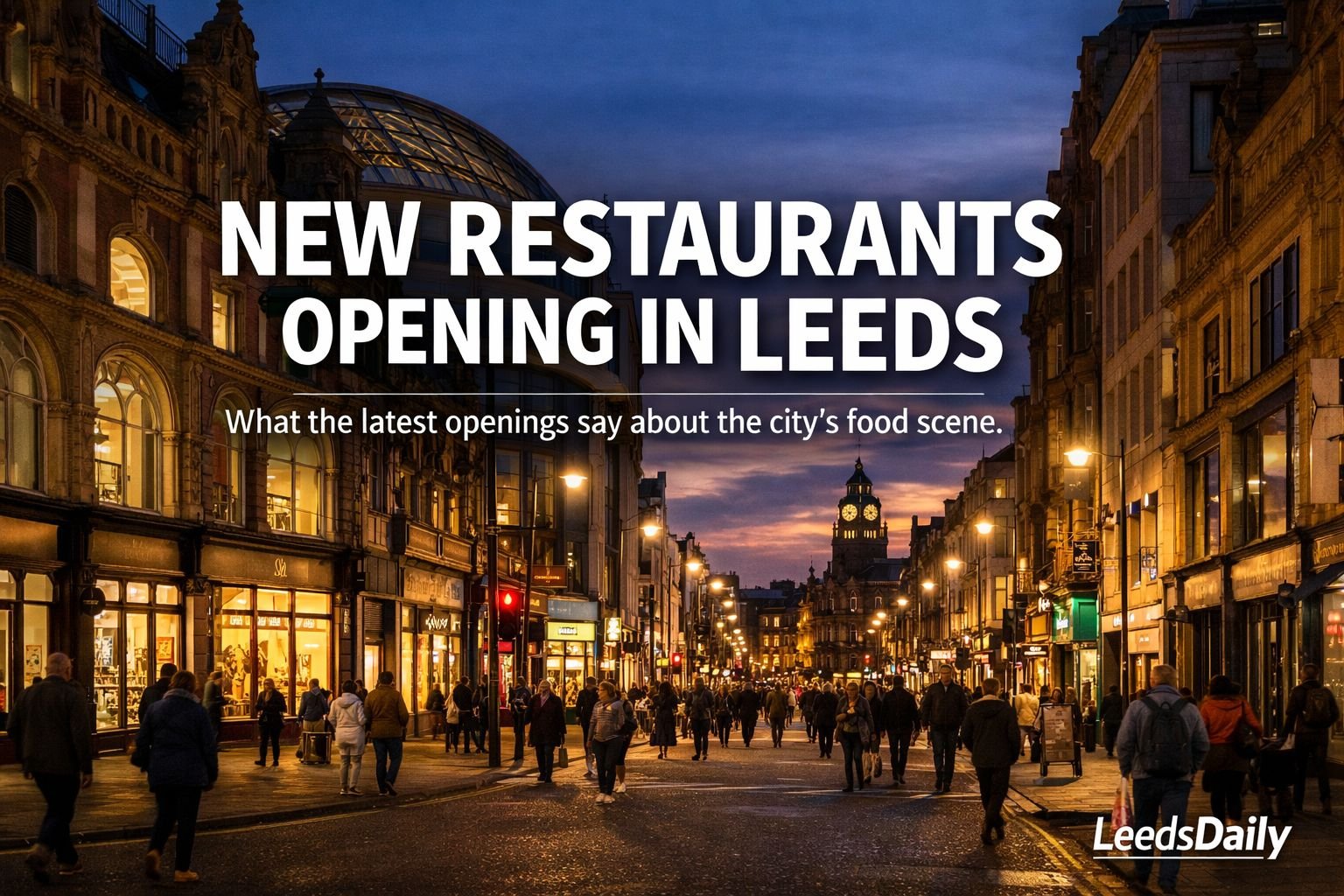
Leeds is entering a defining period for its food and drink sector. Over the coming months, a cluster of high-profile openings will bring renewed energy to the city centre and surrounding districts, signalling confidence in a hospitality market that has spent several years navigating economic pressure. These new restaurants in Leeds are arriving with a mix of national recognition and local ambition, reshaping perceptions of the city as a serious dining destination.
For much of the past decade, Leeds has often operated in the shadow of Manchester when it came to attracting major restaurant brands. The current pipeline suggests that balance may be shifting. Investment concentrated around Wellington Place, Vicar Lane and Kirkgate Market points to a reassessment of the city’s potential, both as a regional hub and as a national hospitality market.
New restaurants in Leeds cluster around key city centre districts
One of the most closely watched arrivals is Madre, the Mexican restaurant group that has built a strong following in Liverpool and Manchester since 2019. Its Leeds opening at Wellington Place is expected in the coming weeks, introducing a day-to-night concept rooted in regional Mexican cooking rather than a simplified street food model.
The menu draws on techniques and dishes from Oaxaca, Baja California and Sonora, reflecting a broader trend among new restaurants in Leeds towards more focused, regionally informed cooking. Co-founder Sam Grainger said the decision to expand into Yorkshire followed sustained interest from Leeds diners travelling to existing sites.
Madre will be joined nearby by Salon Madre, a tequila bar and pool hall, reinforcing Wellington Place’s role as a concentrated food and drink quarter serving office workers during the week and social crowds in the evening. The district’s proximity to the train station and growing residential population has made it an increasingly attractive test bed for operators seeking consistent footfall.
Further east, Dishoom is preparing to open on Vicar Lane after securing planning approval to transform the former Flannels department store into a two-floor restaurant. Expected to open in late spring or early summer 2026, the Bombay-inspired brand will occupy a prominent position between Victoria Gate and the Victoria Quarter.
Dishoom’s decision to enter Leeds rather than prioritise further expansion in London or Manchester carries wider significance. The move reflects a shift in how national operators view growth opportunities, with regional cities now seen as capable of sustaining high-volume dining at scale. For the wider landscape of new restaurants in Leeds, Dishoom’s arrival signals growing confidence in the city’s ability to support major hospitality brands.
At Kirkgate Market, a different model is taking shape. Leisure operator STACK has agreed a lease with Leeds City Council to develop a container-style venue within the outdoor trading area. The project will feature multiple street food traders, bars and an events space, extending the market’s role beyond daytime trading.
Expected to open in late 2026 or early 2027, the development reflects a broader strategy to increase evening and weekend footfall. The coexistence of traditional market traders and modern leisure concepts will be closely watched, but the ambition highlights how new restaurants in Leeds are increasingly tied to wider regeneration efforts.
Read Also: Ivy Asia Leeds: Is the City’s Flashiest Restaurant Actually Worth the Price?
Independents strengthen the wider food landscape
Alongside national brands, independent operators continue to reshape the city centre. Federal opened on Boar Lane in late 2025 after building a strong following in Manchester, while House of Koko expanded from Chapel Allerton into a central location following sustained neighbourhood success.
Other recent openings include Tori Nori, a Japanese grill focused on robata cooking, and The Savvy Baker, which launched its first city centre café in Trinity Leeds with production visible to customers. These additions show how independent operators are approaching expansion cautiously, scaling only once demand is proven.
This combination of national investment and independent growth has created a more layered and resilient dining scene than Leeds has sustained in previous cycles. Rather than isolated openings, the city is seeing coordinated clusters that reinforce footfall across districts.
What this wave of openings reveals
The current surge of new restaurants in Leeds differs from earlier periods of growth. Openings are concentrated in defined areas rather than scattered across the city, suggesting a more strategic approach from landlords and operators alike. Casual dining, street food and brunch-led concepts dominate, reflecting wider UK trends towards accessible pricing and repeat custom.
For audiences beyond West Yorkshire, Leeds offers a clear example of how regional cities are shaping the future of UK dining. Lower rents, strong student and professional populations, and an established culture of independent food businesses have created conditions where experimentation feels commercially viable.
Whether this momentum proves sustainable will depend on execution rather than scale alone. Staffing pressures, consumer confidence and competition will test operators over the next year. For now, the message from the industry is consistent. New restaurants in Leeds are no longer speculative. They are a calculated investment in a city that is being taken seriously.
Read More: Best Restaurants in Leeds: A Local’s Guide to Where the City Actually Eats in 2026