
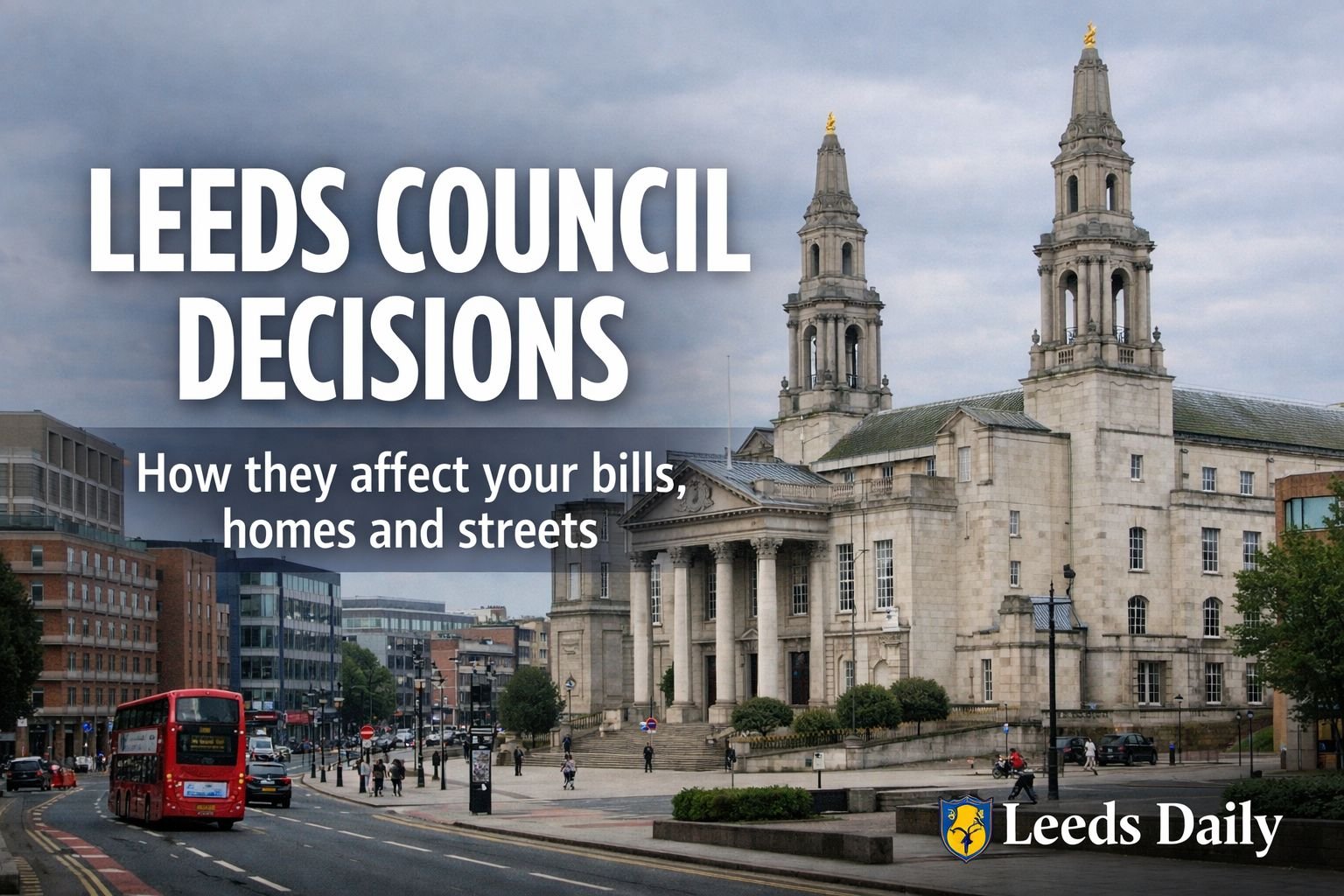
Rising bills, warmer homes, and safer school routes. Those are the real-world changes landing on doorsteps across the city right now, as leeds council news continues to be dominated by budget decisions that will shape daily life in Leeds throughout 2026 and beyond.
At the centre of it all is a council trying to square an impossible circle. After years of squeezed funding, Leeds City Council has welcomed an extra £43.5 million from Westminster this year. But that money barely dents the pressure coming from social care, which now consumes around 60 per cent of the entire budget. Councillors still need to find £39.5 million in savings just to make the numbers add up.
For residents following leeds council news, the message is clear. Some services are being protected, some investments are moving ahead, but tough choices are unavoidable.
What council tax is actually going up by
For most households, council tax in Leeds is rising by just under 5 per cent this year. The core council tax increase stands at 2.99 per cent, with an additional 2 per cent adult social care levy to help fund care for older and disabled residents.
For a Band D property, that means around £90 extra over the year, roughly £1.74 a week. Leeds still has the second-lowest council tax of any comparable English core city, a fact frequently highlighted in leeds council news, but it offers limited comfort to households already grappling with rising living costs.
Councillors insist the increase is unavoidable. By law, the council must set a balanced budget, and demand for children’s services and adult social care continues to rise sharply. Without the increase, deeper cuts to frontline services would have been required.
Crucially, the extra government funding meant some proposed cuts were dropped altogether. Neighbourhood networks will keep their funding after plans for a 10 per cent reduction were scrapped. Free garden waste collections remain, and glass recycling in green bins continues unchanged. These reversals have been among the more quietly welcomed updates in recent leeds council news.
Where the extra money is actually going
Social care remains the dominant issue shaping the budget. The cost of caring for vulnerable children has risen dramatically. Spending on external residential placements has jumped from £68 million to £119 million in just four years, with average placements now costing £6,300 a week. For the most complex cases, costs can reach £1 million per child each year.
On the adult side, the number of people needing council-funded support has increased by 20 per cent over three years, while the care budget has grown by £100 million over the same period. This relentless arithmetic sits behind almost every major item in leeds council news.
To manage the pressure, the council has introduced a recruitment freeze across most departments, with exemptions only for frontline social workers and a small number of income-generating roles. Spending controls have tightened, travel is restricted, and purchases over £500 now require central approval. Despite these measures, the council is still forecasting an overspend of around £40 million this financial year, driven overwhelmingly by social care.
Reserves have been used to plug gaps, but they are running low. The 2026–27 budget includes plans to put £29.9 million back into reserves to rebuild some resilience. Even so, councillors acknowledge this is only a temporary fix unless national funding for social care is reformed.
Housing upgrades coming to Holbeck
Among the most tangible items in recent leeds council news is the £15.9 million investment now under way in Holbeck. Around 180 homes, including council properties, owner-occupied houses, and private rentals, are being upgraded with external wall insulation, new roofs, windows, and doors.
Funded through a mix of regeneration grants and national insulation schemes, the work aims to cut fuel poverty and improve health outcomes by making homes easier and cheaper to heat. For families dealing with damp, cold, and high energy bills, the impact should be immediate.
The project began in January 2026 and is scheduled to finish by spring 2027. It builds on similar schemes already completed in Armley, Little London, and Seacroft, and further investment in Holbeck’s local centre, green spaces, and community facilities is planned later this year. For residents watching leeds council news, it is one of the clearest examples of budget decisions translating into everyday benefits.
Safer routes to school in Middleton and Halton Moor
Parents in Middleton and Halton Moor are also seeing direct effects from council policy. A public consultation is under way on plans to improve walking, wheeling, and cycling routes around six local schools.
Proposals include wider pavements, redesigned junctions, new crossing points, bollards to protect footways, and upgraded street lighting. Although most pupils live within a short walk of their school, car use remains higher than the Leeds average. The council hopes safer routes will encourage families to leave the car at home, easing congestion and improving air quality.
This strand of leeds council news is not just about transport. Safer streets mean fewer accidents, healthier children, and calmer neighbourhoods, particularly around school gates at peak times.
Kirkgate Market continues to receive investment
Despite the pressure on day-to-day spending, capital investment in key city assets has continued. Leeds Kirkgate Market remains a priority, with recent refurbishment work completed on the community hub and library inside the Grade I listed building.
The work follows earlier restoration of the historic blockshops and sits alongside plans for new leisure attractions within the market complex. With around nine million visitors a year and hundreds of businesses trading on site, the market is viewed as both an economic engine and a community space.
In the context of leeds council news, this investment reflects a strategic decision to back assets that generate footfall, jobs, and long-term returns, even while difficult savings are made elsewhere.
Postal voters urged to act before elections
One of the more time-sensitive items in recent leeds council news concerns postal voting. Around 45,000 postal voters in Leeds had still not renewed their details by mid-January, putting their voting method at risk ahead of the May 2026 local elections.
Changes introduced under the Elections Act 2022 mean postal voters must reapply every three years and complete an identity check. Anyone who missed the 31 January deadline will now need to vote in person.
With around 160,000 registered postal voters, Leeds has one of the highest totals of any comparable city. Council officials have urged residents not to assume their registration rolls over automatically, warning that missing the deadline could mean losing a vital voting option.
Crown green bowling gets a reprieve
Community sport has also featured heavily in leeds council news. Plans to close up to 30 council-owned bowling greens to save £140,000 a year have been paused, with all 61 greens now set to remain open until at least the end of the 2025 summer season.
The council is holding discussions with clubs about long-term options, including shared sites and community-led maintenance. Bowling greens may seem minor in budget terms, but they play a significant role in neighbourhood life, particularly for older residents. The decision to delay closures reflects an attempt to balance savings with social impact.
What happens next with the budget
Initial budget proposals were considered in December 2025, followed by a public consultation. Final decisions were taken at the full council budget meeting in February 2026, turning months of leeds council news speculation into concrete commitments.
The challenge now is delivery. The council must achieve £39.5 million in savings while managing rising demand for care services. A new multi-year funding settlement from central government offers greater certainty until 2028–29, but it does not resolve the underlying funding gap.
Why staying informed matters
Council decisions can sound technical, wrapped in figures and committee language. But their impact is personal. They shape the warmth of your home, the safety of your child’s walk to school, the future of community spaces, and the care available to vulnerable residents.
Following leeds council news helps residents understand not just what has been decided, but why trade-offs are being made and where there is still room to influence outcomes. As Leeds continues to grow and change, those decisions will only become more consequential.
Right now, the council has some breathing space thanks to extra funding. Whether that proves to be a turning point or just a pause before the next round of tough choices is the question that will dominate leeds council news in the months ahead.
Read More: Leeds City Centre: What’s Changed in the Last Year and Why Locals Feel the Difference