
In January 2026, a severe G4 geomagnetic storm pushed the aurora borealis far south from its Arctic home, producing rare sightings across England. In West Yorkshire, some Leeds residents who ventured outside that evening reported faint pinks and greens stretching across the Northern Lights Leeds sky. It was not Iceland or Norway, but back gardens, local parks, and nearby moorland.
Events like this raise a recurring question. Can the northern lights leeds really be seen, or are such sightings exaggerated?
The answer is measured and grounded in science. Northern lights Leeds sightings are real, but uncommon, and they require a precise alignment of solar activity, weather conditions, and location. This guide explains what Leeds residents need to know, where visibility is possible, and why patience matters more than hype.
What Are the Northern Lights?
The aurora borealis occurs when electrically charged particles from the Sun collide with oxygen and nitrogen molecules in Earth’s upper atmosphere. These collisions release energy as visible light, creating shimmering curtains and arcs that usually appear near the magnetic poles.
The Sun constantly emits a stream of particles known as the solar wind. During periods of heightened activity, especially coronal mass ejections (CMEs), enormous quantities of plasma are expelled into space at extreme speeds. When these particles interact with Earth’s magnetic field, they are channelled towards higher latitudes and collide with atmospheric gases at altitudes between 100 and 300 kilometres.
Green light is the most common colour and is produced by oxygen at lower altitudes. Pink and purple hues indicate nitrogen excitation, while rare red auroras occur at extreme altitudes during particularly intense geomagnetic storms.
Can You See the Northern Lights in Leeds?
The short answer is yes, but not often.
Leeds sits at approximately 53.8 degrees north latitude, well south of the usual auroral oval, which typically lies between 60 and 75 degrees north. Under normal geomagnetic conditions, the aurora remains invisible from West Yorkshire. For northern lights Leeds sightings to occur, solar activity must intensify enough to push the auroral oval significantly south.
This only happens during strong or severe geomagnetic storms. Even then, visibility is not guaranteed, especially within the city itself.
Understanding the KP Index
The KP index measures geomagnetic activity on a scale from 0 to 9. For Leeds residents, this scale is critical.
- KP 5: Aurora visible from northern Scotland
- KP 7: Potential visibility across northern England, including Leeds
- KP 9: Extremely rare storms extending aurora into southern England and beyond
For northern lights Leeds sightings, a KP index of 7 or higher is typically required. This corresponds to a G3 (strong) or G4 (severe) geomagnetic storm. Such events are uncommon and occur only a few times per solar cycle.
Light Pollution: Leeds’ Biggest Obstacle
Light pollution significantly limits aurora visibility across Leeds. According to national night-sky surveys, the city falls into one of the highest light-pollution categories in England. The urban glow extends far into surrounding areas, washing out faint celestial displays.
Within central Leeds and densely populated suburbs, streetlights, commercial buildings, and traffic create persistent artificial brightness. During even confirmed aurora events, city-centre observers may see only a pale glow on the northern horizon, while darker rural locations experience more defined structures and movement.
Why Northern Lights Appear in the UK
Aurora visibility in the UK is governed by the Sun’s activity cycle, which operates on an approximately 11-year rhythm.
Solar Cycle 25 and Increased Activity
The current solar cycle, known as Solar Cycle 25, entered its maximum phase in 2024 and is expected to remain active through at least 2026. During solar maximum, the Sun produces more sunspots, solar flares, and CMEs, increasing the likelihood of geomagnetic storms that can bring aurora further south.
Recent measurements show Solar Cycle 25 exceeded early forecasts, explaining why aurora sightings across Yorkshire increased during 2024 and early 2026. These events were not random, but a predictable outcome of heightened solar activity monitored by organisations such as the Met Office.
Best Places Near Leeds to See the Northern Lights
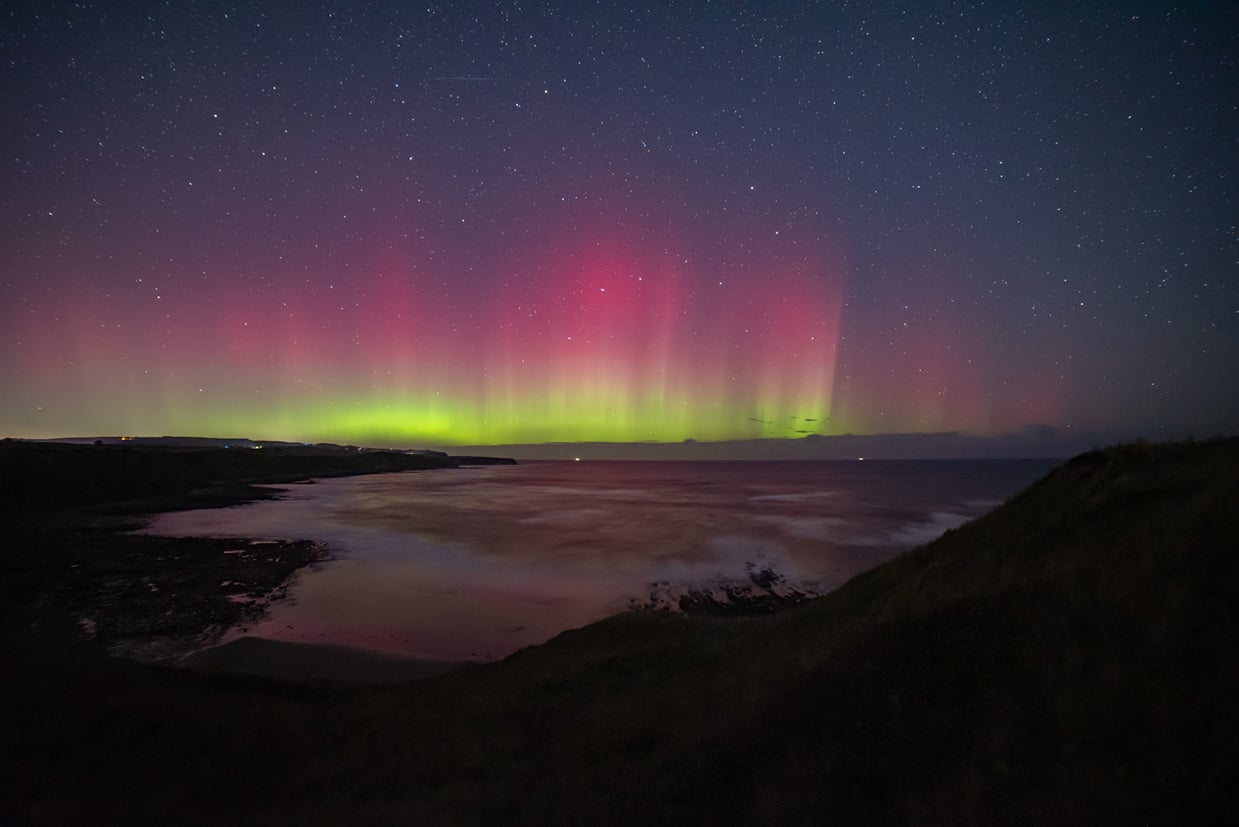
Escaping light pollution is essential for any realistic chance of seeing the aurora.
Yorkshire Dales National Park
Located around 23 miles from Leeds, the Yorkshire Dales offer some of the darkest skies in northern England. Several designated dark-sky sites provide open northern horizons and minimal artificial light.
North York Moors National Park
Approximately 45 miles east of Leeds, the Moors benefit from coastal darkness and elevated inland viewpoints. North-facing views over the North Sea can enhance aurora visibility during strong storms.
Otley Chevin Forest Park
Just 10 miles from Leeds, Otley Chevin provides a closer option. While light pollution remains present, its elevation and north-facing escarpment make it one of the better local choices during KP 7 or higher events.
Ilkley Moor
Ilkley Moor offers open, elevated ground with wide northern views and is frequently used by West Yorkshire aurora watchers during strong geomagnetic activity.
Best Time and Conditions to See Northern Lights in Leeds
Aurora can occur at any time of year, but visibility requires darkness.
In the UK, the prime season runs from late August to early April. Within a given night, activity often peaks between 10pm and 2am, although aurora can intensify unexpectedly outside this window.
Clear skies are essential. Cloud cover completely blocks visibility, regardless of solar activity. Moonlight can also reduce contrast, particularly during weaker displays.
How Often Are Northern Lights Visible in West Yorkshire?
Even during solar maximum, northern lights Leeds sightings remain relatively rare.
- During solar minimum, sightings may occur once every few years
- During solar maximum, visibility may increase to several nights per year
- Strong storms capable of producing widespread UK aurora occur only a handful of times per decade
Recent years have been unusually active, but expectations should remain realistic. Many successful sightings involve faint structures or colour visible primarily through camera sensors rather than the naked eye.
What Leeds Residents Should Know Before Going Out
- Expect subtle displays rather than vivid curtains
- Allow time for eyes to adapt to darkness
- Mobile phone cameras may reveal more colour than human vision
- Be prepared for multiple unsuccessful attempts
Photography, patience, and flexibility greatly improve the experience.
Common Myths About Northern Lights in England
Aurora only happen in Scotland
Strong geomagnetic storms can push visibility much further south.
Aurora require extreme cold
Temperature is irrelevant. Darkness and solar activity matter.
Cameras fake the colours
Long exposures capture real photons that are simply too faint for human vision.
Are Northern Lights in Leeds Rare or Real?
They are real, and they are rare.
Northern lights Leeds sightings depend on powerful solar storms, clear skies, and a willingness to leave the brightest parts of the city. During periods of heightened solar activity, particularly through 2026, West Yorkshire residents have better odds than in previous decades.
For those prepared to monitor space-weather alerts and travel to darker locations, the aurora borealis is no longer just a far-northern phenomenon. On the right night, under the right conditions, it can appear quietly above the moors and dales of Yorkshire.
Read More: Ricky Gervais Leeds: What His Mortality Show Revealed About the City and British Comedy